The most efficient homes rarely shout their superiority—they whisper it. You feel it in the evenness of the temperature, the absence of drafts, the way winter sunlight warms without glare and summer brightness never becomes oppressive. For discerning homeowners, windows are no longer mere apertures; they are precision instruments shaping comfort, efficiency, and long-term value. This article explores how sophisticated window choices can transform your home into a thermally poised sanctuary, with five exclusive insights that go beyond the usual “double vs. triple pane” conversation.
Reframing Windows as Precision Climate Instruments
When approached thoughtfully, windows become a subtle yet powerful component of your home’s energy architecture. Rather than asking only, “How much heat do these lose?” a more refined question is, “How can these contribute intelligently to my home’s climate performance?”
Premium window systems manage three critical dimensions simultaneously: conductive heat transfer (how much heat passes through the glass and frame), radiant energy (how sunlight is admitted or reflected), and air movement (how much uncontrolled air passes around or through the assembly). High-performance windows no longer simply block the outdoors; they curate it.
An energy-efficient window specification is therefore not a single decision, but a coordinated ensemble: glass package, gas fill, coatings, spacers, frame material, and installation method. Each element contributes to what you feel standing near the glass on the coldest night in January or the brightest afternoon in July. The goal is effortless, stable comfort—without overburdening your mechanical systems.
Exclusive Insight #1: The “Edge World” of Windows Matters More Than You Think
Most homeowners focus on the center of the glass, but the perimeter—where glass meets spacer, and spacer meets frame—is frequently the weakest link in an otherwise high-end system. This “edge world” often determines whether a room feels quietly luxurious or subtly compromised.
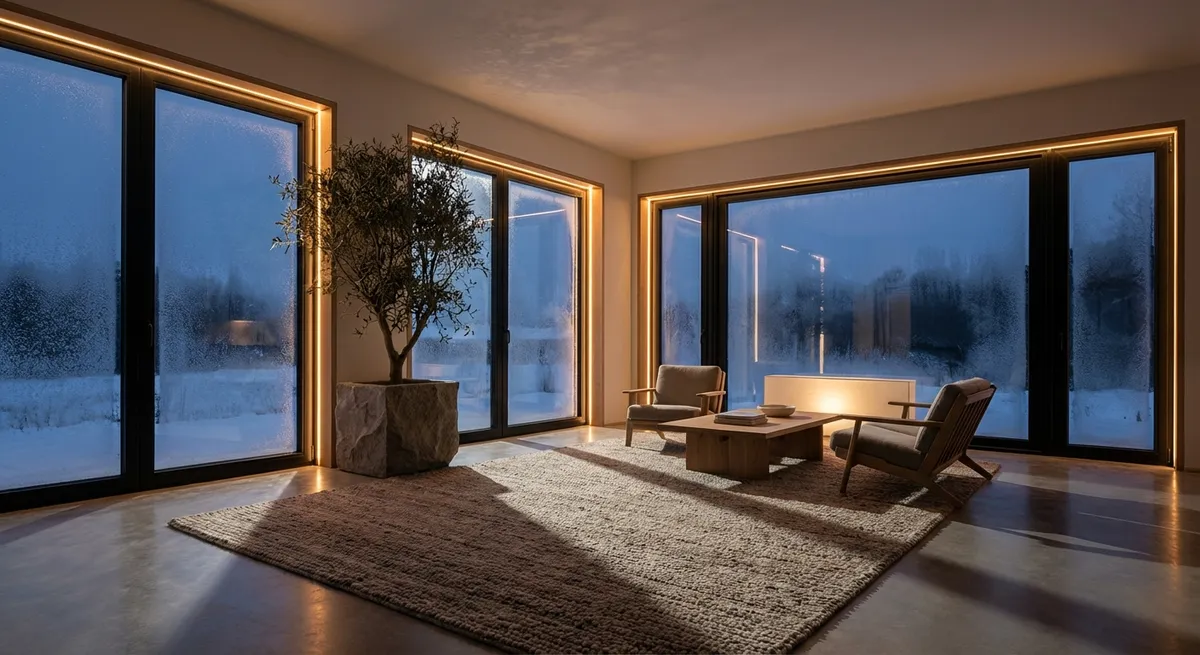
Thermally broken or “warm-edge” spacers dramatically reduce heat transfer at the perimeter of the glazing unit. Compared to older metal spacers, premium composite or stainless designs reduce condensation risk, surface temperature fluctuations, and uncomfortable downdrafts near the glass. In colder climates, this translates directly into perceived comfort: no more hugging the sofa away from the window wall.
The refinement extends to frame design. High-performance fiberglass, wood-clad, or well-engineered composite frames with internal thermal breaks preserve the integrity of the glass package. Poorly insulated frames can undermine even the most advanced glazing. If your goal is a consistent, enveloping sense of comfort, prioritizing edge performance is not a technical detail—it is a luxury prerequisite.
Exclusive Insight #2: Quiet Energy Efficiency—How Better Windows Tame HVAC Noise
Though rarely discussed in energy-efficiency conversations, exceptional windows can meaningfully transform your relationship with your mechanical systems. By reducing unwanted heat loss and gain, well-designed fenestration allows for smaller, quieter HVAC equipment and fewer abrupt on/off cycles.
Instead of an oversized furnace or air conditioner roaring to life to counteract leaky glass, a right-sized system paired with efficient windows maintains temperature in gentle, barely perceptible adjustments. The result is a form of acoustic luxury: fewer drafts, fewer pressure imbalances, less fan noise, and a more serene interior soundscape.
From an engineering perspective, lower and more predictable thermal loads enable sophisticated controls—like variable-speed compressors and modulating boilers—to operate in their most efficient ranges. From a lifestyle perspective, you are purchasing not only reduced utility bills, but also a more composed, less mechanical-feeling home. Premium windows, in this sense, are collaborators in a quieter, more refined interior environment.
Exclusive Insight #3: Reading U-Factor and SHGC as a Paired Signature, Not Isolated Numbers
Many homeowners have learned to look for “low U-factor” or “low-e glass,” but premium decision-making requires understanding how U-factor (insulation) and Solar Heat Gain Coefficient (SHGC) interact in your specific climate and orientation. Treat them as a pair—a thermal “signature”—rather than independent metrics.
In cold-dominant climates, a low U-factor (good insulation) combined with a moderately higher SHGC on south-facing elevations can allow your windows to harvest winter sun while minimizing nighttime losses. In cooling-dominant regions, you might still pursue a low U-factor, but pair it with a significantly lower SHGC to prevent overheating and reduce air conditioning loads.
The most refined strategy is elevation-specific. South-facing windows may justifiably have a different SHGC than western exposures that fight harsh afternoon sun. North-facing glazing, which receives little direct sun, can prioritize insulation over solar gain entirely. A premium window upgrade, therefore, is not a single blanket specification for the entire home but a calibrated palette, tuned by orientation, use of space, and regional climate.
Exclusive Insight #4: Daylighting as an Energy Strategy, Not Just a Design Luxury
Exceptional windows do more than retain heat; they can subtly redesign the way your home uses light. Intelligent glazing, frame profiles, and window placement can significantly reduce reliance on artificial lighting—often overlooked in energy-efficiency decisions.
High-performance low-e coatings tailored for visible light transmission allow generous natural daylight while filtering infrared heat. Slimmer, structurally robust frames increase glass area without compromising performance, bringing more ambient light deeper into the space. The result is a brighter yet thermally controlled interior, where electric lights are needed less often and at lower intensities.
For work-from-home offices, kitchens, and living spaces, this has measurable and experiential value: lower lighting loads on your utility bill, fewer harsh contrasts between daylight and artificial light, and a calm, evenly illuminated environment. Daylighting, when coordinated with shading and efficient glass, becomes an integral part of a holistic efficiency strategy, rather than a purely aesthetic aspiration.
Exclusive Insight #5: Future-Proofing for Emerging Standards and Resale Expectations
Today’s “premium” quickly becomes tomorrow’s baseline. Energy codes and buyer expectations are steadily rising, and windows sit at the intersection of regulatory performance and visible quality. Choosing advanced windows today is a way of future-proofing both comfort and property value.
As jurisdictions progressively adopt stricter building-energy standards and as electrification and net-zero-ready homes become more common, fenestration that merely meets current minimums may begin to feel dated. Superior thermal performance, laminated or acoustic glazing, and thoughtfully selected low-e coatings all position your home ahead of the curve.
In the resale conversation, high-performance windows are one of the few visible efficiency upgrades a prospective buyer immediately registers. A buyer may not see the insulation in your walls, but they will see and feel the difference in your windows—how they move, how they sound, how they perform on a cold or hot day. For the cultivated homeowner, energy-efficient windows are therefore both a daily comfort investment and a strategic asset in a more discerning market.
Conclusion
Refined window selection is not about chasing a single “best” glass or frame, but orchestrating a suite of intelligent decisions: controlling heat at the edges as much as in the center, quieting mechanical systems by reducing loads, pairing U-factor and SHGC thoughtfully by orientation, leveraging daylight as an energy ally, and anticipating the performance standards of tomorrow.
For those seeking a home that feels composed in every season—neither drafty in winter nor stifling in summer—windows are the quiet protagonists. Approached with care, they transform from necessary openings into sophisticated climate instruments, enhancing not only efficiency but also the lived experience of every room they frame.
Sources
- U.S. Department of Energy – Energy-Efficient Windows - Overview of window performance metrics, glazing technologies, and energy-saving strategies
- Efficient Windows Collaborative – Window Selection Guidance - Detailed guidance on U-factor, SHGC, climate-specific recommendations, and design considerations
- Lawrence Berkeley National Laboratory – Windows and Daylighting - Research on thermal performance, daylighting, and advanced glazing technologies
- ENERGY STAR – Most Efficient Windows - Criteria and performance thresholds for top-tier residential window products
- U.S. Environmental Protection Agency – Energy Efficiency in Buildings - Context on how building envelope improvements, including windows, contribute to broader energy-efficiency goals
Key Takeaway
The most important thing to remember from this article is that this information can change how you think about Energy Efficiency.