For the design-aware homeowner, a window upgrade is never just about swapping glass and frames. It is an opportunity to recalibrate how a space feels, performs, and ages. The installation phase is where theory meets craftsmanship—where a well-chosen product either fulfills its promise or quietly underperforms for decades. When handled with rigor and care, installation becomes less a construction task and more a curated experience that subtly transforms the character of the home.
Below are five exclusive, often-overlooked insights that distinguish a merely adequate window installation from one worthy of a premium residence.
1. The Substructure Story: Why Your Wall Matters More Than Your Window
A window is only as refined as the wall that receives it. Before a single sash is set, a sophisticated installer will interrogate the substructure: probing for hidden moisture, subtle framing shifts, and insulation voids that compromise performance.
Premium practice begins with a forensic-style assessment. Stud alignment, sheathing condition, and existing flashing are evaluated in concert. Any irregularity—slight rot in a sill plate, a bowed stud, a hairline crack in exterior cladding—is addressed proactively. This ensures the new window is not simply “fit to the hole” but precisely integrated into an optimized opening.
The reward is threefold: a cleaner visual reveal, quieter operation, and a significantly lower risk of long-term movement, air leaks, or water intrusion. Homeowners who insist on detailed substructure preparation are effectively commissioning a hidden layer of craftsmanship that will never appear on a brochure—but will be felt in comfort and longevity every day.
2. Performance by Millimeters: The Art of the Installation Gap
To the untrained eye, the space between the new window and the rough opening is invisible. To a meticulous installer, it is the performance control zone. That slim perimeter gap determines whether your investment delivers on its promises of efficiency, silence, and durability.
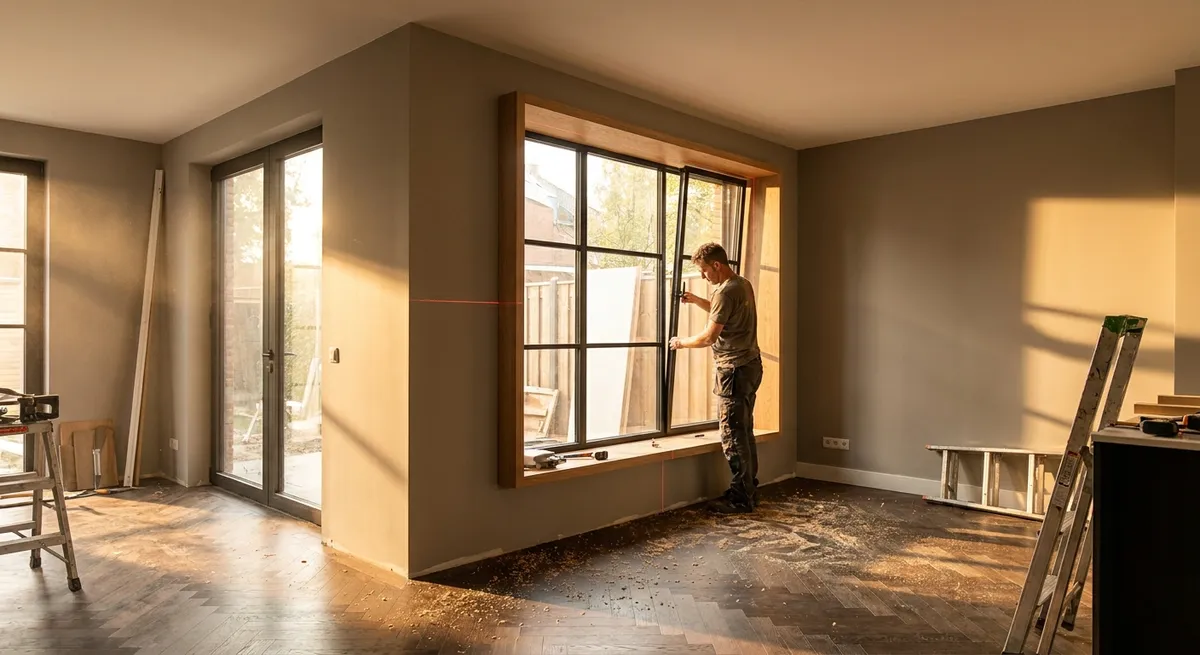
When this gap is too wide or too tight, the frame can rack, seals can fatigue, and hardware can strain over time. In a refined installation, the opening is calibrated so the window sits plumb, level, and square with precise tolerances. The gap is then filled not with generic foam, but with carefully selected materials—low-expansion foam or mineral wool—matched to climate, framing type, and product specifications.
This is where high-end projects distinguish themselves: attention to expansion, contraction, and load transfer ensures windows operate with an almost watch-like precision, year after year. The result is a sash that closes with a gentle, confident click, rather than a forced shove.
3. Invisible Weather Management: Layered Protection Behind the Trim
The most elegant installations look almost effortless from the interior: seamless casing lines, clean corners, and consistent reveals. Yet the true sophistication lies just beneath the surfaces, where water and air are silently managed in carefully layered systems.
A premium installation uses a coordinated sequence of flashing tapes, sill pans, sealants, and weather-resistive barriers—not as a collection of products, but as an intentionally designed assembly. Sill pans are subtly sloped to direct any incidental moisture outward. Flashing is shingled in proper order, ensuring water moves down and away, never inward. Sealants are chosen for compatibility with both the window material and the surrounding cladding, avoiding premature failure or staining.
For homeowners, this means a window that not only looks perfectly integrated on day one but continues to protect the building envelope quietly for decades. It is the architectural equivalent of a bespoke lining inside a well-tailored jacket: rarely seen, but fundamental to how it wears and performs over time.
4. Thermal Continuity: Aligning the Window with Your Insulation Strategy
Most discussions of energy efficiency focus on glass performance—low-E coatings, gas fills, and U-factors. Yet the physical position of the window within the wall can significantly influence how well it collaborates with your overall insulation strategy.
In well-conceived installations, the window is aligned with the wall’s “thermal center”—often closer to the insulation layer rather than flush to the interior or exterior face. This alignment reduces thermal bridging and drafts, creating a more even surface temperature on interior finishes and a greater sense of comfort near the window.
Advanced installers coordinate with designers or energy consultants to determine optimal placement for the specific wall assembly: traditional stud walls, exterior continuous insulation, or high-performance assemblies all call for nuanced positioning. The result is a window that does not merely comply with efficiency standards, but actively enhances the room’s thermal calm—cooler interiors in summer, cozier perimeters in winter, and less reliance on mechanical systems to mask weak points.
5. Refined Integration: Hardware, Sightlines, and Daily Rituals
The finest window installations are calibrated not just for performance, but for how you will live with them—how your hand meets a latch, how your eye travels across a frame, how light unfolds across a wall throughout the day.
Subtle decisions during installation have outsized influence on these daily rituals. Handle heights can be harmonized across a room for an intentional visual rhythm. Mullions can be aligned with existing architectural lines—door heads, cabinetry tops, or wainscoting—to create a quiet sense of order. Casement swings can be oriented to frame preferred views and facilitate natural ventilation patterns. Even the choice of interior trim profile and its junction with the window frame shapes the perceived quality of the aperture.
Thoughtful homeowners treat installation as a final act of design refinement, not a mechanical step. By engaging with these details—asking how windows open, where they align, and what they frame—you ensure your investment yields not just better performance metrics, but a more elevated everyday experience.
Conclusion
Window installation, at its highest level, is an exercise in precision, anticipation, and discretion. It knits together structural integrity, weather protection, thermal performance, and tactile pleasure into one quiet, enduring upgrade. For homeowners accustomed to seeking out the most considered solutions, the difference between standard and elevated installation is not just technical—it is experiential.
By focusing on substructure preparation, exacting gap control, invisible weather management, thermal alignment, and refined integration, you transform a routine home improvement into an architectural enhancement that feels both intentional and timeless. The result is not merely a new view, but a more composed, resilient, and exquisitely finished home.
Sources
- U.S. Department of Energy – Energy-Efficient Window Attachments – Overview of how windows and their assemblies impact home energy performance
- Efficient Windows Collaborative – Window Selection and Installation – Technical guidance on proper window installation and its influence on efficiency
- Building America Solutions Center – Window and Door Flashing Details – In-depth resources on flashing, weather management, and integration with wall systems
- FGIA (Fenestration & Glazing Industry Alliance) – Proper Installation Practices – Industry recommendations for high-performing fenestration installations
- Green Building Advisor – Installing Windows for High Performance – Practical, expert-level insights on placement, thermal alignment, and air/water management
Key Takeaway
The most important thing to remember from this article is that this information can change how you think about Installation.