Windows are no longer passive openings in a wall; they are architectural instruments that choreograph light, comfort, and aesthetic value. For the discerning homeowner, choosing window types is less about filling a gap and more about orchestrating an experience—of views, privacy, thermal comfort, and effortless daily living. The right selection of window forms can subtly recalibrate how a space feels, functions, and performs for decades.
This guide explores refined window typologies through a design-forward lens and offers five exclusive insights that sophisticated homeowners should consider before committing to their next upgrade.
Understanding Window Typologies as Architectural Tools
Most window catalogues reduce the conversation to a familiar roster: casement, double-hung, awning, picture, sliding, bay, bow, and specialty shapes. While this taxonomy is useful, it is also incomplete if the objective is to design a home that feels intentionally curated rather than merely equipped.
Casement windows, hinged at the side, excel at capturing breezes and delivering a clean, contemporary profile with minimal sightlines. Double-hung windows, with their vertically sliding sashes, offer a more traditional rhythm to the façade and controlled ventilation from top and bottom. Awning windows provide discreet ventilation even in light rain and pair beautifully with fixed “picture” units to deliver uninterrupted views. Sliding windows deliver horizontal movement and low-profile operation, ideal where swing space is limited.
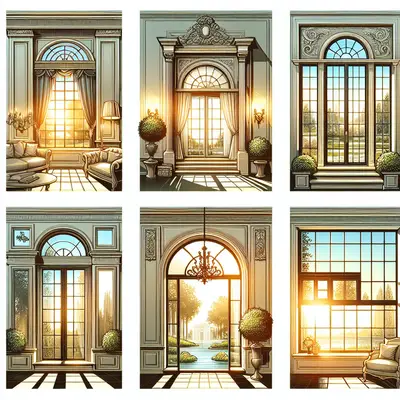
Beyond these familiar categories, there are architectural windows—arched, trapezoidal, or custom-shaped—that exist as sculptural elements as much as functional openings. Bay and bow windows, projecting from the façade, create interior alcoves that behave like built-in furniture: reading nooks, breakfast corners, or contemplative perches. When approached thoughtfully, each type becomes a tool in a larger composition of light, privacy, and spatial experience rather than a standalone product decision.
Performance and Presence: Matching Window Types to Room Intent
The highest-caliber window strategies begin with a simple question: what should this room feel like at 8 a.m., at noon, and after dark? Window types are then chosen to manifest that answer.
In a kitchen, operable windows such as casement or awning units near cooking and prep zones offer rapid ventilation and precise control of fresh air. In a living room where the view is the protagonist, fixed picture windows with exceptionally slim frames deliver a gallery-like framing of the exterior, often balanced by smaller operable units on the flanks for airflow. Bedrooms may favor double-hung or tilt-and-turn styles that allow gentle night ventilation while maintaining a sense of enclosure.
Bathrooms demand a subtle equilibrium: awning windows placed high on the wall, frosted or textured for privacy, permit daylight and steam relief without exposing the interior. Stairwells, often neglected, can be transformed with tall, narrow fixed windows or continuous clerestory bands that draw in daylight and sculpt shadow patterns across the steps, turning circulation space into an architectural moment.
When window types are aligned with the emotional and functional intent of each room, the home feels intuitively “right”—not because any one window is extraordinary, but because the ensemble has been orchestrated with quiet precision.
Materiality and Mechanisms: Elevating Everyday Use
Refined window design is as much about tactile experience as it is about aesthetics or performance metrics. The choice between wood, aluminum, fiberglass, or composite frames is partly technical—but it is also experiential.
Wood interiors, properly finished, lend warmth and visual depth, particularly in living and sleeping spaces where natural materials are part of the design language. Aluminum-clad exteriors offer crisp lines, exceptional durability, and a curated palette of finishes that maintain architectural integrity over time. Fiberglass and high-end composites provide dimensional stability, slender profiles, and low maintenance—ideal for large expanses of glass where strength and longevity are paramount.
Hardware and operating mechanisms should feel precise and reassuring: multi-point locking on casements, smoothly gliding tracks on sliding units, or the quiet, deliberate motion of tilt-and-turn systems. The difference between adequate and exceptional windows is often felt in the hand rather than seen from across the room. Premium solutions prioritize not only thermal and acoustic performance, but also the daily ritual of opening and closing, ensuring that the windows invite use rather than resist it.
Five Exclusive Insights for the Discerning Homeowner
The following nuances rarely appear in basic window guides, yet they meaningfully distinguish a sophisticated window strategy from a merely competent one.
1. Design for “Layered Transparency,” Not Just View
Instead of thinking in binary terms—transparent versus opaque—consider windows as layers of graduated transparency. Combining fixed picture windows with operable flankers, clerestory bands with lower, more private openings, or clear glass with selective obscured sections creates a nuanced visual relationship with the outdoors.
For example, in an urban setting, a tall window with frosted glass at eye level and clear glass above can admit daylight and sky views while softening neighboring buildings and shielding interior life. This approach respects both the view and the need for discretion, ensuring your glazing strategy feels curated rather than exposed.
2. Calibrate Ventilation by Orientation and Window Type
Not all window types move air equally, and not all façades experience wind in the same way. Casement windows that can be angled into the prevailing breeze will outperform sliding units on the same wall. On a leeward side, operable awning windows positioned high can facilitate stack ventilation by allowing warm air to escape.
By mixing types—such as casements on windward façades and tilt-and-turn or double-hung units facing calmer exposures—you create a natural ventilation system that reduces reliance on mechanical cooling. This is particularly impactful in shoulder seasons, where thoughtful operability can noticeably reduce energy use while preserving comfort.
3. Use Specialty Shapes to Resolve Awkward Transitions
Architectural “leftovers”—sloping roofs, corner conditions, or tall voids above standard door heights—are often patched with drywall, when in fact they are prime real estate for specialty windows. A slender triangular clerestory under a pitched roof or a narrow corner window that wraps two walls can elegantly resolve otherwise awkward geometry.
These bespoke shapes do more than add visual interest: they draw daylight deeper into the plan and diminish the sense of heavy, unused volume near ceilings, making spaces feel taller, lighter, and more composed.
4. Think in Window Ensembles, Not Individual Units
Sophisticated window design considers how multiple types converse across a façade and throughout the interior. Instead of selecting each window in isolation, conceive of “ensembles” that repeat and vary with intention.
For instance, a primary elevation might feature a recurring motif: a tall fixed pane paired with a slimmer operable casement, repeated at different scales. On secondary façades, that language might simplify but remain legible. This coherence subtly elevates the home’s architecture, signaling a deliberate design rather than an assortment of catalog options.
5. Future-Proof with Hidden Flexibility
A refined window plan anticipates how your life—and the building’s performance standards—may change. This can include framing rough openings to accommodate potential future enlargement, even if the initial window is more modest, or selecting systems compatible with future upgrades such as integrated shading, smart sensors, or higher-performance glazing.
In practice, this might mean choosing a modular window system whose components can be re-glazed with improved low-E coatings or laminated glass down the line, or ensuring that wiring for motorized shades is concealed within the head jamb. These details preserve the elegance of the present while making future enhancements seamless rather than invasive.
Curating Comfort: Glass, Shading, and Acoustic Refinement
While frame types and operating styles define the visible character of a window, glass and shading determine much of its experiential quality. High-performance glazing—low-emissivity coatings, gas fills such as argon or krypton, and warm-edge spacers—subtly refine the home’s thermal balance, improving comfort near windows in both summer and winter.
In sun-exposed rooms, consider aligning window types with an integrated shading strategy: deep-set picture windows paired with exterior overhangs on south façades; operable units framed by side fins or vertical louvers on east and west; and more modest openings where glare is likely to be persistent. Internally, the choice between sheer and blackout treatments, or between visible hardware and concealed tracks, can reinforce the window’s architectural role.
Acoustically, laminated glass paired with thoughtfully sealed operable units can transform the interior soundscape, particularly in urban or high-traffic locations. The subjective experience of quiet—of hearing only what you choose to hear—is a hallmark of elevated window solutions and should be considered a core performance criterion alongside energy efficiency.
Conclusion
Selecting window types for a premium home is not a checklist exercise; it is a design dialogue between architecture, landscape, climate, and lifestyle. When you think in terms of typologies, ensembles, and layered performance—rather than individual units—you step into a more sophisticated realm of decision-making.
By appreciating the nuanced roles of operability, materiality, special shapes, and future-proof detailing, you position your home to feel not just upgraded, but thoughtfully composed. Windows become what they should always have been: instruments of light, privacy, comfort, and quiet luxury, framing a daily experience that feels both effortlessly functional and aesthetically resolved.
Sources
- U.S. Department of Energy – Types of Windows - Overview of common residential window types and their performance implications
- Efficient Windows Collaborative – Window Selection - In-depth guidance on window performance, glazing choices, and climate considerations
- University of Minnesota – Windows and Daylighting - Research-based discussion of window design, daylighting strategies, and visual comfort
- Pella – Window Materials and Frame Options - Manufacturer insight into material choices and their impact on aesthetics, maintenance, and durability
- Marvin – Architectural Window Design Considerations - Case-based perspectives on integrating window types into cohesive architectural compositions
Key Takeaway
The most important thing to remember from this article is that this information can change how you think about Window Types.